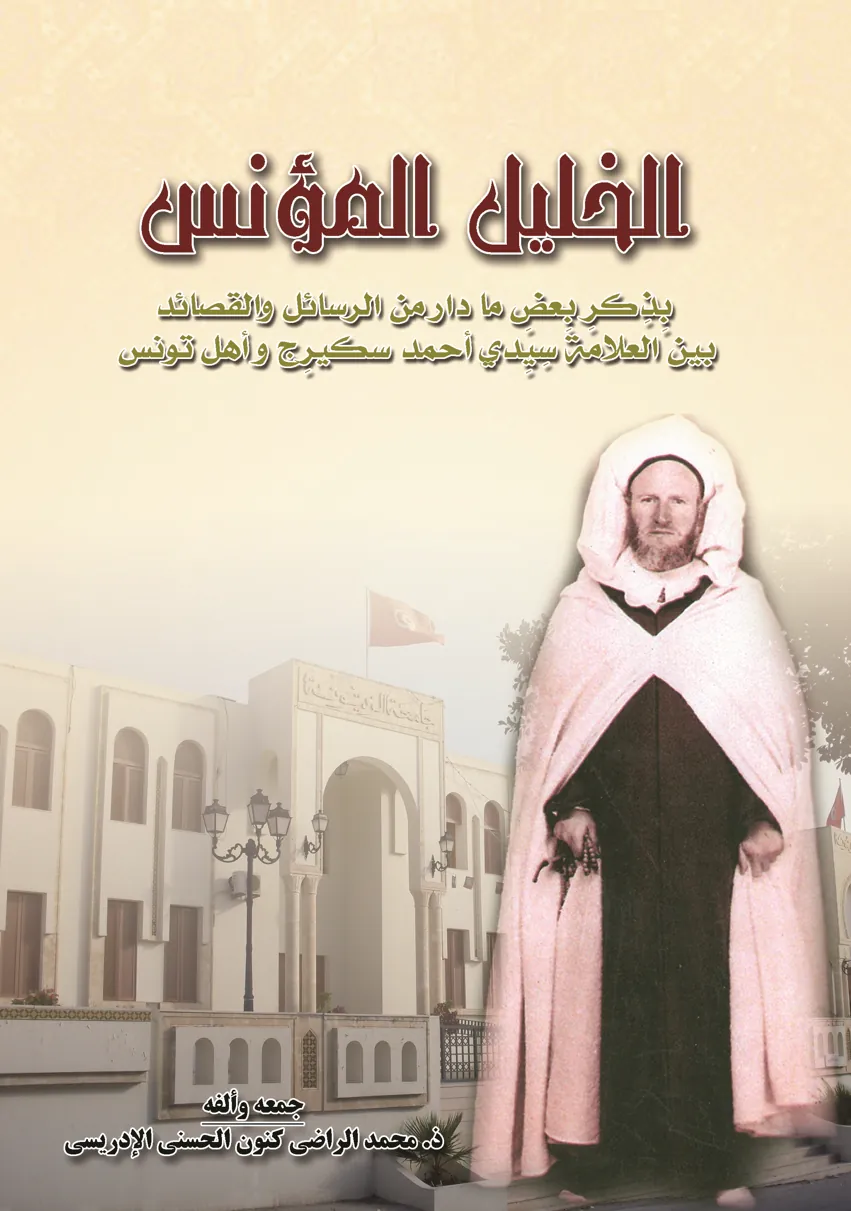
Tunisia: a major scholarly home of the Tijaniyya around al-Zaytuna
Tunisia holds an important place in the scholarly history of the Tijaniyya. It is home to one of the oldest and most prestigious institutions of learning in the Muslim world, the Zaytuna Mosque-University, which for centuries served as a center for jurists, muftis, men of letters, and spiritual masters.
The Tijani path in Tunisia developed within this high scholarly environment. One of its most important foundational figures was Sidi Ibrahim Riyahi, a great Tunisian scholar, a leading shaykh of al-Zaytuna, and one of the foremost representatives of the Tijaniyya in the country. He had taken the path from Sidi Hajj Ali Harazem Berrada, the great khalifa of Sīdī Aḥmad al-Tijānī. This lineage helps explain both the depth and the early establishment of the Tijaniyya in Tunisia.
From that point onward, a number of muftis, senior teachers, major shaykhs, and scholars of al-Zaytuna were Tijanis. Many of them maintained correspondence with the scholar Sidi Ahmed Skiredj, often consulting him in order to verify certain rulings, judgments, doctrinal points, and issues related to the path, its practice, and its defense.
Tunisia therefore appears not merely as a land where the Tijaniyya was present, but as a place where it became a school of learning, adab, transmission, and refined legal-spiritual reflection.
The beginnings of Sidi Ahmed Skiredj’s relations with Tunisian scholars
Sidi Ahmed Skiredj maintained warm and lasting ties with many scholars of Tunisia. It appears that these relations began early in his life, especially through his deep friendship with the learned man of letters Sidi Omar Riyahi, a descendant of Sidi Ibrahim Riyahi.
Sidi Omar Riyahi visited Morocco several times. His first meeting with Sidi Ahmed Skiredj took place at the great zawiya in Fez around 1328 AH, and he met him again in Tangier during the same visit. Two elements strongly reinforced the affinity between them: adab and poetry. Their intellectual and spiritual closeness is evident in the many letters and literary exchanges that passed between them over a long period.
About six years after this first meeting, Sidi Ahmed Skiredj himself visited Tunisia for the first time. He did so while serving as a member of the Society of the Awqaf of the Two Holy Sanctuaries, whose gathering was held in Tunis. This visit allowed him to establish ties with many Tunisian scholars, notables, and officials. He even composed a qasida in praise of the Bey of Tunis, Muhammad al-Nasir ibn Muhammad al-Husayni, which was greatly appreciated and later earned him a distinguished reception and a high decoration.
A Tunisian Tijani network closely linked to Sidi Ahmed Skiredj
From this opening, the relations between Sidi Ahmed Skiredj and the Tijani scholars of Tunisia became increasingly strong. Sidi Omar Riyahi played a particularly important role by facilitating contact between Skiredj and several of the best-known representatives of the path in Tunisia.
Among them were:
Muhammad al-Sadiq ibn al-Tahir al-Riyahi
Hammouda ibn Muhammad Taj
Muhammad al-Mukhtar Chouikha
Muhammad al-Bashir al-Nayfar
Muhammad ibn Yusuf al-Hanafi
Jalloul ibn Muhammad al-Jaziri
Mu'awiya al-Tamimi
and others.
Sidi Ahmed Skiredj benefited greatly from these relationships. He met these scholars, sat with them, discussed matters related to tasawwuf and the Ahmadi Tijani path, gathered from them many accounts and details concerning the history of the path in Tunisia, and drew on their knowledge in order to understand the local Tunisian Tijani reality more fully.
His repeated journeys to Tunisia further deepened these connections. He even had some of his own works printed there under the supervision of one of his dear disciples, the learned man of letters Mu'awiya al-Tamimi, who helped spread them throughout Tunisia with the assistance of Jalloul ibn Muhammad al-Jaziri al-Husayni, another major Tunisian Tijani figure closely linked to him.
His ties with Tunisian notables and state figures
Sidi Ahmed Skiredj’s Tunisian relations were not limited to scholars of the path. He also maintained strong ties with a number of leading Tunisian notables, high-ranking officials, and men of government, who showed him esteem, affection, and regard.
Among them were:
al-Hadi al-Akhwa, grand vizier
Mustafa Dinguizli, who also held the grand vizierate
Muhammad al-Habib al-Jallouli, minister of justice and one of his dearest friends
Mustafa al-Safar, shaykh of the city of Tunis
Muhammad ibn al-Khuja, governor of Bizerte
Ahmad ibn al-Rais, minister of the pen
Khalil Bouhajeb, shaykh of Tunis
and others.
These relations show that Sidi Ahmed Skiredj was seen in Tunisia not as a distant outside figure, but as an important scholarly, literary, and spiritual personality with real standing in the country’s higher circles.
His relations with the great scholars and fuqaha of Tunisia
Alongside the explicitly Tijani figures, Sidi Ahmed Skiredj also maintained ties with several major Tunisian scholars and jurists who were not necessarily Tijani, but who respected him, corresponded with him, and valued his scholarship.
Among them were:
Muhammad al-Joudi al-Qayrawani
Salim Bouhajeb
the Maliki mufti Balhassan ibn Muhammad al-Najjar
the Hanafi mufti Ahmad ibn Muhammad ibn Mustafa Bayram
This shows that Sidi Ahmed Skiredj’s reputation extended beyond the internal circle of the Tariqa. He was recognized for his learning, literary refinement, strength in argument, and mastery of legal, doctrinal, and spiritual matters.
The case of Ahmad Bayram is especially noteworthy. He is described as having had a particularly special affection for Skiredj, even saying to him, “You are me, and I am you.” Sidi Ahmed Skiredj responded with elegant verses expressing closeness, spiritual intimacy, and the pain of separation.
Sidi Omar Riyahi: friendship, poetry, and learned exchange
Among the most important Tunisian figures in the circle of Sidi Ahmed Skiredj, Sidi Omar ibn Muhammad ibn Ali ibn Sidi Ibrahim Riyahi occupies a very special place. He was a faqih, a man of letters, a historian, and one of the notable representatives of the Tijani path in Tunisia, known for piety, worship, and virtue.
He was one of Skiredj’s oldest Tunisian friends. Their friendship is well attested by the abundance of letters, replies, and literary exchanges between them. Their relationship stands as one of the finest examples of the meeting between learning, spirituality, and literature in the wider Maghribi Tijani world.
Hammouda ibn Muhammad Taj: a Zaytuna scholar and man of the path
Sidi Abu Muhammad Hammouda ibn Muhammad Taj was a jurist, a man of letters, and a teacher. He studied at al-Zaytuna under a number of major scholars, among them Hussein ibn Ahmad, Salim Bouhajeb, Muhammad al-Najjar, Ammar ibn Saidan, and others.
He later taught at al-Zaytuna and became one of its major scholars. At the same time, he was among the close adherents of the Ahmadi Tijani path, devoted to its litanies and deeply attached to it in love and practice. His letter to Sidi Ahmed Skiredj, and the verses he addressed to him, reflect the admiration and esteem he held for him.
He died in 1338 AH, and was elegized by scholars including Muhammad ibn Yusuf al-Hanafi and his disciple, the mufti Mahmoud Moussa.
Muhammad al-Mukhtar Chouikha: learning, administration, and service to the path
Muhammad al-Mukhtar Chouikha was another prominent figure who combined scholarship, literary accomplishment, and high administrative service. Trained in the Zaytuna environment, he attained a high level in the sciences, excelled in writing, poetry, and calligraphy, and held important offices in the Tunisian administration.
Yet he remained deeply attached to the Tijani path, known for integrity, probity, reverence for the Prophet’s household, and deep love for Sīdī Aḥmad al-Tijānī and his way. His career illustrates a characteristic Tunisian synthesis of refined scholarship, public service, and Tijani spirituality.
Muhammad al-Bashir al-Nayfar: jurist, khatib, mufti, and defender of the path
Muhammad al-Bashir ibn Ahmad al-Nayfar was one of the major Tunisian scholars of the twentieth century. He was a jurist, teacher, khatib, mufti, and qadi, and he was also a Tijani.
His correspondence with Sidi Ahmed Skiredj is especially revealing. It shows that Skiredj encouraged him to write in defense of the Tijaniyya and to refute the falsehoods and accusations spread by its opponents. This was natural, since al-Nayfar possessed major scholarly, cultural, and literary weight in Tunisia, making him well placed to serve as one of the path’s intellectual defenders in his own country.
This demonstrates that the relationship between Tunisian scholars and Sidi Ahmed Skiredj was not merely one of affection or courtesy. It was also a form of concrete intellectual cooperation in the service of the path.
Muhammad al-Sadiq al-Riyahi: heir to the Riyahi house and bearer of broad transmission
Another notable figure was Muhammad al-Sadiq ibn al-Tahir al-Riyahi, a descendant of the famous Riyahi family in Tunisia. He was one of the major scholars who combined mastery of the path with transmitted and rational sciences.
Sidi Ahmed Skiredj requested an ijaza from him, and he initially refrained until he himself received an ijaza from Skiredj, in a gesture of humility and scholarly reciprocity. He then authorized Skiredj in everything he possessed regarding the Tijani path, as well as in the transmitted and rational sciences according to what he had received from his own teachers.
This episode clearly illustrates the depth of the relationship between the two men: it was not only mutual admiration, but a true exchange between two heirs of knowledge and transmission.
Tunisia as a place of printing, circulation, and scholarly consolidation of the path
One of the striking features of the Tijani presence in Tunisia was its integration with:
the institutional teaching of al-Zaytuna
scholarly circles
zawiyas
literary assemblies
and the world of printing and publication.
In Tunisia, Sidi Ahmed Skiredj found not only correspondents and admirers, but also partners in the publication and dissemination of his works. A number of his writings were printed there, supervised, revised, and spread by his Tunisian disciples. This makes Tunisia, alongside Morocco and Egypt, another important center in the circulation of Tijani texts.
Conclusion: Tunisia in the scholarly history of the Tijaniyya
Tunisia thus emerges as one of the major scholarly centers of the Tijaniyya, rooted in the tradition of al-Zaytuna and marked by the foundational figure of Sidi Ibrahim Riyahi, who had taken the path from Sidi Hajj Ali Harazem Berrada.
Through its muftis, scholars, shaykhs, men of letters, and public figures, Tunisia played an important role in preserving the path, teaching it, clarifying its questions, defending it, and spreading its writings.
The close ties that many of its major scholars maintained with Sidi Ahmed Skiredj confirm that Tunisia formed an integral part of the broad Tijani scholarly network linking Fez, Tunis, Cairo, West Africa, and other important centers of spiritual and intellectual radiance.
Linked figures
(0)Linked books
(0)Linked articles
(0)Bibliographic references
(1)These references are explicitly associated with this region in the documentary world map materials.