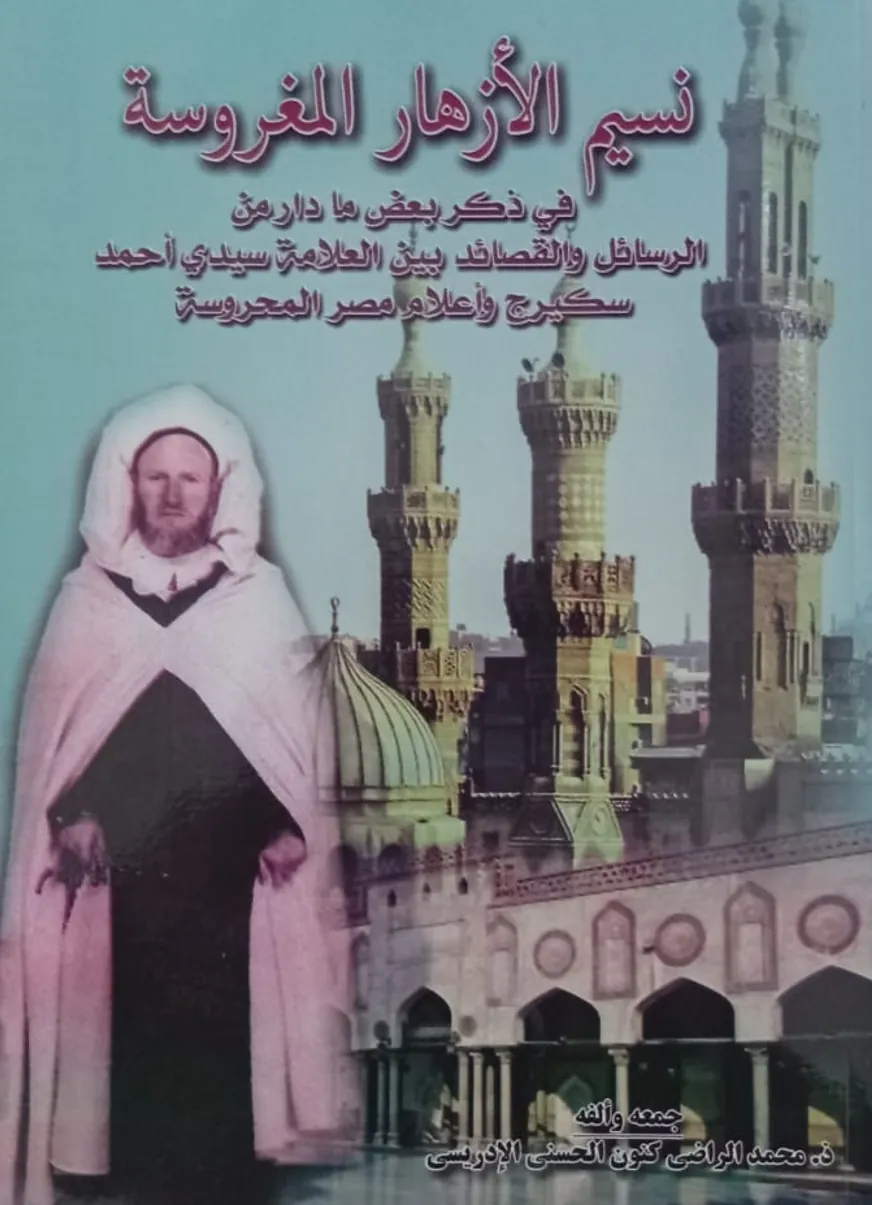
Egypt: a major intellectual hub of the Tijaniyya
If West Africa witnessed a spectacular popular spread of the Tijaniyya, Egypt, for its part, became a major scholarly and strategic center for the expansion of the path throughout the Muslim world.
Thanks to the central role of Al-Azhar, Egypt occupied a privileged position in connecting scholars, students, and Tijani circles across Africa, the Maghreb, the Levant, the Hijaz, and beyond. In that period, Al-Azhar was a meeting place for students from many Muslim lands, which made Egypt a true crossroads for the circulation of books, chains of transmission, scholarly debates, spiritual correspondence, and organized Tijani activity.
In this context, a number of major Egyptian scholars played a decisive role in teaching, defending, organizing, and spreading the Tijani path. All of them maintained close and meaningful ties with the great Moroccan scholar Sidi Ahmed Skiredj, whom they regarded as one of the foremost authorities of the order in the twentieth century.
The letters exchanged between Sidi Ahmed Skiredj and these Egyptian figures clearly show that Egypt was not merely one country among others where the Tijaniyya was present. It was rather a major intellectual and organizational platform that helped link Morocco to the eastern Arab world, and North Africa and West Africa to the broader Muslim scholarly universe.
Among the most prominent of these Egyptian figures were Shaykh Muhammad al-Hafiz al-Tijani, Muhammad Sa'id Ali Efendi, Hussein Hassan al-Tamawi, Hussein Ahmad al-Shaykh, Hassan Taj al-Din Ashour, and others who contributed through scholarship, correspondence, publishing, distribution, and spiritual guidance.
Shaykh Muhammad al-Hafiz al-Tijani: scholar, hadith master, and defender of the path
Sidi Muhammad al-Hafiz al-Tijani was one of the leading Tijani figures in Egypt and one of its greatest servants in terms of scholarship, transmission, and defense of the path.
He was widely recognized as a man of major learning: a jurist, a scholar of hadith, a memorizer, and a spiritual guide with deep concern for the affairs of the Ahmadi Tijani path.
His relationship with Sidi Ahmed Skiredj began around 1349 AH / 1930 CE, through the mediation of the learned Muhammad Sa'id Ali Efendi, who played a key role in introducing the two men to one another.
Muhammad al-Hafiz al-Tijani played an important role in spreading the Tijaniyya among students and scholars in Egypt, especially in circles connected to Al-Azhar. His correspondence shows a particular concern for the correct transmission of awrad, for the verification of chains and formulations, and for the defense of the path against criticisms raised in scholarly environments.
His letters to Sidi Ahmed Skiredj reflect a profound spiritual and intellectual respect. He turned to him in difficult questions, asked for his judgment on doctrinal and practical matters, and treated him as a major authority in the path.
He also authored significant works in different fields and made a major contribution to defending the principles, values, and foundations of the Tijaniyya.
He passed away during the night of Monday 29 Jumada II 1398 AH / 5 June 1978 CE, and with his death Egypt lost one of its most distinguished Tijani scholars of the modern period.
Muhammad Sa'id Ali Efendi: connector, organizer, and facilitator of scholarly circulation
Muhammad Sa'id Ali Efendi was one of the most important practical organizers of the Tijani network in Egypt.
He was the one who facilitated the introduction between Sidi Ahmed Skiredj and Shaykh Muhammad al-Hafiz al-Tijani, which makes him one of the key scholarly intermediaries in this Egyptian circle.
But his role was much broader than that of a simple intermediary. His letters show that he was deeply involved in:
circulating Tijani books
shipping works between Egypt, Morocco, Sudan, Senegal, and other regions
coordinating among muqaddams and Tijani circles
ensuring that major writings reached the appropriate networks.
His correspondence reveals an active infrastructure of publication, transport, and distribution, showing that Egypt was not only a place of oral learning, but also a major center for Tijani printing and book circulation.
He also maintained a respectful and warm relationship with Sidi Ahmed Skiredj’s family, especially with Sidi Abd al-Karim Skiredj, which further illustrates how closely the Egyptian network was tied to the Skiredj household and its intellectual legacy.
Hussein Ahmad al-Shaykh: one of the leading Egyptian disciples of Sidi Ahmed Skiredj
Hussein Ahmad al-Shaykh was among the most important disciples of Sidi Ahmed Skiredj in Alexandria.
His relationship with the shaykh was direct and personal. In fact, Sidi Ahmed Skiredj stayed in his house in Alexandria during his passage through Egypt on his way to the Hijaz in 1352 AH / 1933 CE.
This detail is highly significant, because it reflects trust, closeness, and a special place within the circle of the shaykh’s Egyptian disciples.
Hussein Ahmad al-Shaykh was also particularly active in the printing, publishing, and distribution of books, especially the writings of his teacher, Sidi Ahmed Skiredj. He devoted much effort to this work over a long period and corresponded frequently with him regarding matters of publication, printing, shipment, and dissemination.
His importance is even clearer when one sees that he was connected not only to his own teacher, but also to many major disciples of Sidi Ahmed Skiredj in other lands, including:
the former sultan Moulay Abd al-Hafid
Sidi Muhammad al-Khalifa Niass
Sidi Ibrahim Niass
Sidi Muhammad ibn Ali al-Susi al-Baydawi
Sidi Muhammad ibn Abd al-Rahman Mghara
the Mufti of Oran, Sidi al-Habib ibn Abd al-Malik
and others.
This shows that Hussein Ahmad al-Shaykh was part of a broad international network through which books, letters, and scholarly-spiritual ties circulated.
Hussein Hassan al-Tamawi: a scholar from Upper Egypt who united trade, scholarship, and Sufism
Hussein Hassan al-Tamawi was one of the major Tijani figures in Egypt. He was born in the town of Tama, in Sohag province in Upper Egypt, in 1269 AH / 1852 CE.
After memorizing the Qur’an, he studied under local scholars and later joined Al-Azhar, where he learned from some of the important scholars of his time. He later worked in the timber trade and became known for it, yet his worldly occupation did not prevent him from pursuing religious learning and spiritual refinement.
From an early age he had a strong inclination toward Sufism and devoted much attention to its books and teachings. He took the Tijani path from major figures, among them:
Banati Adam al-Falati
Alfa Hashim al-Futi
and then the great scholar Sidi Ahmed Skiredj.
He became deeply attached to Sidi Ahmed Skiredj, considered him a major authority in the path, and received from him a lasting authorization in both the restricted and unrestricted Tijani chains.
One especially striking point is that al-Tamawi was around thirty years older than Sidi Ahmed Skiredj, yet he consistently showed him great respect and acknowledged the breadth of his knowledge and his deep understanding of the path.
His letters portray a serious and careful mind, eager to verify matters relating to chains of transmission, permissions, litanies, and the limits of what may or may not be taken from broader scholarly transmissions.
He died in 1354 AH / 1935 CE, and was succeeded at the Tijani zawiya in his town by his son Hasan. Sidi Ahmed Skiredj later elegized him in a long poem.
Hassan Taj al-Din Ashour: gnostic, author, and major Egyptian Tijani figure
Hassan Taj al-Din Ashour al-Qawsi was one of the most important Tijani figures in Egypt, and one of those who combined scholarship, spiritual insight, authorship, and guidance.
Born in 1287 AH / 1870 CE, he left numerous works, including:
al-Nafahat al-Qudsiyya
Fann al-Maqal
al-Kanz al-Mutalsam
al-Bidaya wa al-Nihaya.
Researchers have preserved and examined many of his letters to Sidi Ahmed Skiredj, and these letters are marked by deep reverence, admiration, and recognition of his rank. They reflect the strength of the bond between the two men.
This is made even more remarkable by the fact that Hassan Taj al-Din was older than Sidi Ahmed Skiredj by approximately eight years, and yet clearly acknowledged his superiority in spiritual authority and educational leadership.
His correspondence also reveals the difficult circumstances faced by the Tijaniyya in some parts of Egypt, including confusion, disputes, false claims, and attempts at fragmentation. In those circumstances he turned to Sidi Ahmed Skiredj for clarification, support, and decisive guidance, which once more shows that the latter functioned as a higher reference point for many of Egypt’s Tijani scholars.
Hassan Taj al-Din died in 1412 AH / 1991 CE in al-Qusiya in Upper Egypt, where he was buried. His shrine remained well known and visited.
Egypt as a network of publication, circulation, and connection in the Tijani world
Egypt’s role in the history of the Tijaniyya was not limited to the presence of a few great scholars. It also extended to its function as a central network for printing, circulation, and coordination.
The letters make it clear that Cairo, Alexandria, and other Egyptian cities served as major stations for:
printing books
copying manuscripts
dispatching works to Senegal, Sudan, Morocco, and elsewhere
coordinating between muqaddams
and helping unify scholarly and organizational efforts.
The presence of Al-Azhar contributed decisively to this role, since Egypt brought together students and scholars from different lands. As a result, the Tijani presence in Egypt took on a dimension that far exceeded the local setting and became part of a wider Muslim intellectual geography.
For this reason, Egypt fulfilled a dual role:
on the one hand, it was home to major scholars and muqaddams
on the other hand, it was a main corridor for the transmission of Tijani knowledge across multiple regions.
Conclusion of the Egyptian section
The study of the correspondence and relationships linking Sidi Ahmed Skiredj with major Egyptian scholars shows that Egypt was one of the foremost intellectual centers of the Tijaniyya in the twentieth century.
There converged:
the scholarly prestige of Al-Azhar
the energy of publication and book circulation
the presence of jurists, hadith scholars, Sufis, and learned men
and a living connection to a global network stretching from Morocco to West Africa, the Hijaz, and the Levant.
Egypt was therefore not simply one more country of the Tijani path. It was a major scholarly and strategic hub in its international expansion, and a living example of how learning, spiritual training, publishing, and organization could work together in the service of the Tijaniyya.
Linked figures
(0)Linked books
(0)Linked articles
(0)Bibliographic references
(1)These references are explicitly associated with this region in the documentary world map materials.